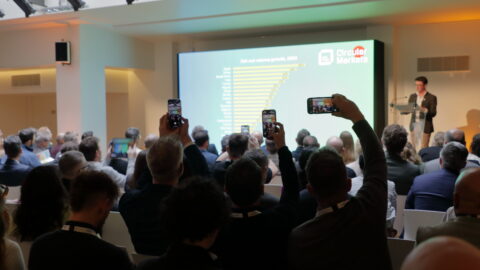
For the second year in a row, Foxway had the honor to support the Circular Markets event organized by CCS Insight. The event in London saw over 300 participants from 34 countries all over the world. The audience included OEMs, MNOs, retailers, marketplaces, 360° circular tech enablers like Foxway, automation experts, analysis, and other prominent players in the telecom and circular tech field.
Nearly twice the size as the first time around, the event strengthened its position as a key annual gathering for the circular mobile industry. The event offered strong intelligence and reinforced key market trends. The overall industry mindset has shifted from problem-solving to opportunities that focus on innovations to set standards across device lifecycles and build seamless customer journeys.
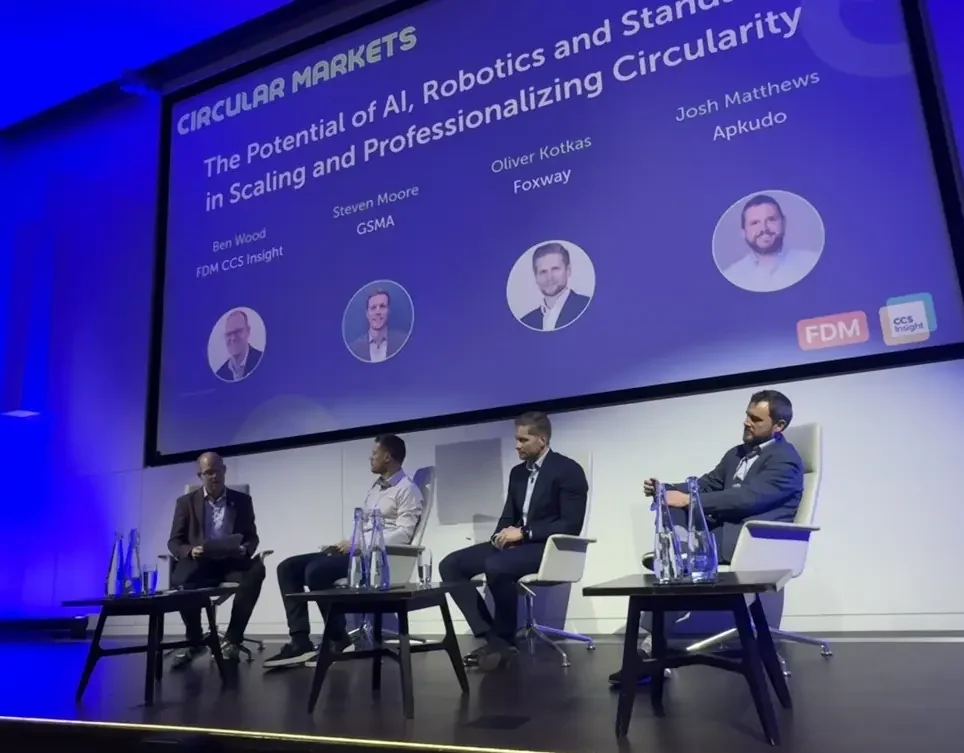
In one of the panel sessions, Oliver Kotkas (Operations Director at Foxway), Steven Moore (GSMA), Josh Matthews (Apkudo), and Ben Wood (FDM | CCS Insight) explored how AI, robotics and industry standards can professionalize circularity. Next, we’ll highlight some of the key takeaways Oliver Kotkas shared from Foxway’s point-of-view.
Automation in isolation delivers little value
The circular tech industry is entering a new phase. What was once driven by individual pioneers and fragmented initiatives is now shaped by science-based targets and rising consumer expectations for seamless customer journeys. OEM-certified programs are expanding, operators are integrating circularity into their sales strategies, regulatory frameworks are catching up to support the secondary market needs.
Successfully scaling circularity from an operations perspective needs the same holistic end-to-end approach:
“If you approach automation as a standalone process to minimize some costs in processing, that’s all the value you will get out of it. To maximize the potential of automation and robotics, we need to look at the entire customer journey. Automation can bring exponential growth, especially in data insight, and your commercial strategy should be 10 steps ahead of your first visible step in automation.”
Oliver Kotkas, Operations Director at Foxway
Building on the experience of automation projects at Foxway, Oliver Kotkas used the recently announced Foxway Circular Platform, as an example to illustrate the end-to-end plan. With the AI-powered visual and functional diagnostics increasing grading accuracy, the whole process becomes simpler for both store employees and end-consumers, making it possible to enable scalable and transparent trade-ins.
We’re in the data selling business
Gathering data and turning it into insight are two different things. Complete in-house capabilities paired with automation, robotics, and AI will enable us to use data in a way that will start impacting how we eventually shape the end-user customer journey. Get the right product to the right customer.
“At Foxway, we get thousands of data points per device, and the number will only continue to grow as automation evolves. Utilizing this insight to find the best fit between value-add and customer segments is what will increase trust in pre-owned devices and raise residual values. That is intelligent use of data.”
Oliver Kotkas, Operations Director at Foxway.
This shift is particularly relevant as grading inconsistencies have historically created and continue to create uncertainty for the end-users. When condition categories vary between vendors, consumer expectations follow the same inconsistency. In turn, discrepancies and return rates increase, residual values suffer. With intelligent use of data, we have the possibility to move beyond optimizing processes and start influencing commercial outcomes.
While keeping scalability in mind, Oliver highlighted the importance of not sacrificing transparency and trust in the process. A key distinguisher for Foxway is keeping all capabilities in-house and within Europe. Aside a clear pathway to intelligent data use, the same set-up reinforces alignment with sustainability commitments and provides a solid ground for influencing industry norms and standards.
Automation and AI as enablers of consistency
The panel addressed the need to put more focus on what is and isn’t happening to the devices as they move from one user to the next. Companies focusing only on reuse have the advantage of moving products quickly while those with in-house refurbishing expertise navigate the same game with their own rulebook.
“For us, it’s never been about simply moving devices from one owner to another. While about half of incoming devices are an ideal fit for automated flows, the remaining 50% need value-uplift in one form or another. Automation is not the solution to everything, but it gives you scalability. When volumes ramp up, you need predictable throughput, systems that support technicians and to reduce variation where it can and should be reduced.”
Oliver Kotkas, Operations Director at Foxway
Foxway’s example of fine-tuning this balance between skilled in-house technicians and automation resonated with the rest of the panel: the latter is an enabler to boost value recovery and quality assurance with long-term impact.
The panel noted that we’re just at the beginning of seeing how AI will reshape the industry. While careful not to overpromise on the role and influence of AI in the entire decision-making process, participants agreed it will increase speed, increase end-consumer confidence in the secondary market, and ultimately drive higher residual values. All that is especially fundamental for telcos and OEMs.
Looking forward
Circular Markets 2026 gave reason to expect several innovations across the industry. At Foxway, we’ve already begun our journey of embedding automations and AI into the whole device journey so that data-driven intelligence can shape the customer journeys.
Recommerce