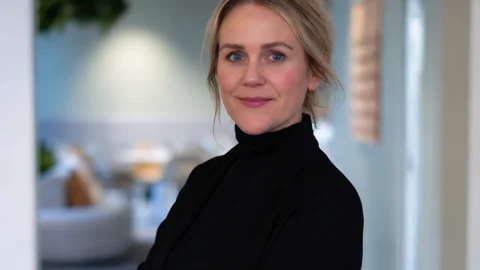
Sara Lindstrand joined Foxway in March 2026, bringing a combination of engineering expertise and sustainability leadership.
Every year in October, International E-Waste Day and World Standards Day put a spotlight on the growing negative impact of electronic devices, and on the standards that can help the tech industry reduce it. In November, the focus shifts to deals and discounts, with sales peaking across industries, tech included. With these themes in mind, we sat down with Sara to talk about her journey into sustainability, what she’s learned during her first months at Foxway, and the role standards and regulation play in making circular tech the first choice and scaling it as a climate solution.
Let’s start with your story. What path led you to sustainability, and eventually to the role of CSO at Foxway?
I’m an engineer at heart, so I’ve always approached sustainability through technology and innovation. The science is clear: we have now crossed seven of nine planetary boundaries. Closing that gap calls for solutions that scale, and if we get the compass right, technology and digitalization are among the most powerful tools we have to build an economy that operates within the Earth’s limits and shape the society we want.
One of my early eye-openers came from reports focusing on conflict minerals in the electronics industry. They shed light on human rights breaches in the extraction of the raw materials inside electronic devices and made it very clear how social issues are built into global value chains. That is even more relevant today, as we use more devices than ever, while we deploy other green technologies and infrastructure that further increase our reliance on critical raw materials.
Having worked with engineering in both product development and throughout the full lifecycle of products, it became evident that every efficiency gain adds up to the wider impact we’re after. As an example, if you improve the fuel efficiency of a combustion engine by a single percentage point, that small tweak becomes a massive CO2e saving over the product’s lifecycle and across every unit on the market. That notion of scaling has stayed with me. Solving the climate crisis isn’t only about reducing your own footprint. It’s about scaling the solutions that help others reduce theirs.
For me, the CSO role at Foxway sits where two megatrends meet: digitalization and sustainability. Most of a device’s climate footprint is locked in before it even enters its use phase, in raw material extraction and in manufacturing. Extending its life through asset management, buyback, repair and refurbishment is one of the most direct ways to avoid those emissions, which makes circular tech a climate solution we can scale today, not one we’re waiting for. As a leader in circular tech, Foxway can support society’s digital transition in a way that also makes it more sustainable.
In your first six months at Foxway, what captured your attention the most, and what did you decide to tackle first?
The visualization of our business model as an infinity loop really resonated with me. It shows clearly how all our services and pieces of the puzzle contribute to circular tech. But I wanted to know the details of how we’re optimizing that loop, including the internal flows within Foxway, to push for initiatives that further strengthen our profitability and competitiveness. Optimizing that loop is both a sustainability and a business priority.
One of the focus areas for our sustainability work was making sure we have sound, science-backed proof points for the claims we make. As a leader in circular tech, we need evidence for why refurbished, or why Device-as-a-Service combining new and refurbished, is the better choice from a carbon, cost, and resiliency point of view. This involves making sure we’re equipped with reliable science-backed data and that it translates easily and transparently to our partners and customers.
Credible data is what allows a climate solution to scale. Customers, investors, and other stakeholders ask not only what you emit, but what you help avoid, and we want to answer with numbers that hold up to independent scrutiny.
Last year, we took a deep dive into the global struggles with e-waste. How do you see the role of circular tech, and Foxway, in tackling the problem?
E-waste is growing five times faster than documented recycling, and the global economy is less than 7% circular — a share that is still falling. Recycling alone won’t close that gap. Keeping devices in use for longer and returning materials to the loop at end of life, is one of the most effective levers we have, and it means fewer devices end up as waste.
But as we highlighted in that article, companies like Foxway help mitigate e-waste and carbon emission, but we can’t eliminate the e-waste challenge on our own. It’s an important distinction to make and to be transparent about such claims. What Foxway does is help change the way we consume devices. We advocate for more sustainable ways of consuming tech, and together with our partners, we can make circular tech principles the new normal.
Foxway holds several ISO certifications and was recently awarded the EcoVadis Platinum rating. Why do they matter in our industry?
Simply put, they are a way of showing that Foxway lives up to the promises and principles we’ve set. EcoVadis Platinum places us in the top 1% of companies assessed globally. That is a very strong position, and it’s something to be proud of.
ISO standards and the EcoVadis assessment are external frameworks that set norms for what a responsible business should have in place. They involve either external audits or an external review of how we operate. Together, they help define the building blocks needed to run a business responsibly.
The bigger question is whether our business model is aligned with what the planet can sustain. Real value and credibility come from embedding circularity in our strategy and business models, and from being able to measure and show that it works. Today, 74% of Foxway’s revenue is circular, which sets us apart in our industry (Foxway Annual & Sustainability Report 2025, p. 9). To keep proving that, we’ve put science-backed data at the center of our work, from how devices flow within Foxway to where they end up once they leave us. That’s how we show circular tech is a real lever for tackling e-waste and the broader climate and social challenges.
The refurbishment industry is also working toward shared quality standards. What can they solve, and where do we still have work to do as an industry?
Quality standards help the industry agree on common practices, a shared baseline for what it means to refurbish responsibly. I believe EUREFAS can be one of the key bodies in bringing the refurbishment industry to a higher level of standardization and harmonization.
How we calculate the environmental impact of refurbishment is a separate conversation, and one we still need to have as an industry to enable comparability and, in the end, strengthen trust in refurbished devices.
Harmonized, critically reviewed impact data is what will move refurbished tech from an alternative to the default, and see it recognized as a climate solution. Here, Foxway has an opportunity to help lead the whole ecosystem toward an evidence-based way of measuring and talking about impact, and to share what we learn.
Most legislation is written with new devices in mind. If you could rewrite any rules tomorrow to boost circular tech, what would they be?
Many of today’s rules were written for a linear economy. Recent laws on ecodesign and repair are a step forward, but if we want an Earth-aligned economy, regulation needs to reward keeping products and materials in use, not only collecting them at end of life.
Extended producer responsibility (EPR) is a good example of legislation that is challenging for the refurbishment sector. The intention is good, but member states have implemented it very differently. My first change would be to fix that fragmentation, so that a company operating across the EU reports to a single EU point.
My second would be to stop charging reuse twice. In several member states, a company selling used and refurbished devices is treated as a producer, even though it hasn’t produced anything new. The same device, already paid for when first sold in another EU country, pays EPR fees twice, compliance costs go up, and the rules end up penalizing the reuse they were meant to encourage.
Looking ahead, the EU’s headline circularity indicator counts recycled material and gives no direct credit for reuse. Our position is that the upcoming Circular Economy Act should reflect the full waste hierarchy, starting with prevention and counting reuse, repair and refurbishment alongside recycling, rather than continuing today’s recycling focus.
Refurbishment relies on new devices entering the market first. What role does “new” play in a circular future?
Circular tech depends on a flow of devices, and there will always be some new production. Devices wear out, technology evolves, and some material is lost in every cycle. The real question is what kind of “new” we want, and how we can minimize the inflow of virgin materials taken from the Earth’s crust.
In the circular future, devices are designed to last, used as long as possible, repaired and refurbished, and eventually taken apart so their components and materials can go back into production. New devices are built with a growing share of recovered materials, reducing our reliance on virgin resources. So, there will always be “new” in a circular future. It just won’t be made primarily from virgin materials. That’s what an Earth-aligned economy looks like: devices, materials, and value keep circulating, and progress no longer depends on extracting more from the planet.
Sustainability We are Foxway